





If you don’t have the cash for a down payment on a new car, you can transform the value of your current vehicle into a down payment with a trade-in deal at your Chevy dealership. Trade-in advantages include a fuss-free process, savings on sales taxes, and avoiding costly repair fees for major mechanical issues.
1. Convenient Process

Trading in your old vehicle at your local dealership is a convenient process that can usually be completed in a day. Unlike selling your car privately, your dealership will handle most of the legwork when it comes to quoting your trade-in and gathering relevant documents, such as vehicle registration. Plus, the trade-in process at your dealership is much faster than privately advertising and selling your vehicle, especially when you quote your current vehicle using your dealership’s valuation tool.
Read the rest of this entry »Supercar Excellence: The 2025 Corvette Z06
If your idea of the perfect supercar is pure track dominance, the 2025 Corvette Z06 is built just for you. This American icon of speed features the most powerful naturally aspirated V8 ever placed in a production car, supported by a suite of race-bred technologies.
Powerful V8 Engine

A 5.5L V8 that redlines at a screaming 8,600 rpm powers the Z06. It is the most powerful naturally aspirated engine equipped in a production car, letting loose 670 hp and 460 lb.-ft of torque. Several motorsport-grade technologies, such as a dry sump oil system and a flat-plane crankshaft, enable the V8 to consistently deliver a high output under various conditions. Additionally, dual throttle bodies and triple tuning valves enhance airflow, allowing the engine to breathe better at high speeds.
Dual Clutch Transmission
To manage the fire-breathing V8’s immense power, the Z06 is equipped with an 8-speed dual-clutch transmission (DCT). The DCT combines the efficient, smooth gear changes of an automatic transmission with the engagement of a manual. It also features a double paddle declutch feature that lets drivers disengage the clutch by using the steering wheel-mounted paddle shifters.
Read the rest of this entry »Three-row mid-size SUVs are more popular than they have ever been because of their balance of cargo space, efficiency, performance, and comfort. The 2025 Chevrolet Traverse is among the leaders in its class thanks to a dependable powertrain, impressive fuel efficiency, spacious interior, and an array of innovative technology amenities that keep drivers connected and engaged.
Powerful, Efficient Drivetrain
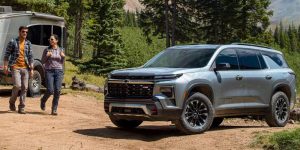
The Traverse’s powertrain gives it the performance needed to chase adventure almost anywhere. It has a 2.5-liter Turbo engine with Variable Valve Timing, Spark Ignition Direct Injection, and Dual Overhead Cams. This powerplant generates 328 horsepower and 326 foot-pounds of torque, and it is matched with an 8-speed Electronic Precision Shift automatic transmission with either a FWD or AWD drivetrain. That makes the Traverse capable on and off the road.
Read the rest of this entry »5 Standout Features of the 2025 Chevrolet Trax
What makes the 2025 Chevrolet Trax stand out from other small SUVs on the market? Check out these five notable features that make the new Trax a perfect match for every driver.
1. ECOTEC 1.2L Turbo Engine
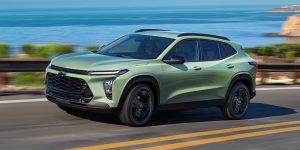
The Chevy Trax comes with an ECOTEC 1.2L Turbo engine that’s paired with a 6-speed automatic transmission for smooth acceleration. This combination generates 137 horsepower at 5000 rpm and 162 lb.-ft. of torque at 2500 rpm. The Trax’s Turbo engine helps you save on fuel costs through automatic stop/start technology, which shuts your engine down at complete stops and restarts it as you let off the brake.
2. Wireless Smartphone Integration
With wireless smartphone integration, you can enjoy hands-free phone calls and texts from behind the wheel of your new Trax. Apple CarPlay and Android Auto use Bluetooth technology to sync your phone’s contents to the infotainment system.
From there, you can use voice controls to make and receive phone calls without taking your hands off the wheel. You can also use your phone on the 8-inch touch screen or with the steering-wheel-mounted controls for the phone interface.
5 Reasons Drivers Love the 2025 Chevrolet Blazer EV
If you’re ready to go electric but don’t want to compromise on performance, you need the 2025 Chevrolet Blazer EV. This impressive two-row SUV delivers on range, power, space, and comfort, making it a great eco-friendly option. We look at just a few of the reasons drivers can’t wait to get their hands on the new Chevy Blazer EV.
1. Electrified Performance and Efficiency
The secret to the Blazer EV’s outstanding performance is its dual-motor propulsion system and the 85 kWh battery that powers it. This efficient setup generates 300 horsepower and 355 pound-feet of torque and allows drivers to travel 283 miles on a single charge.
However, upgrading to the LT trim level and the available rear-wheel layout increases the range to 334 miles, enough juice to take you on a road trip to Rhode Island without having to recharge.
4 Benefits of Leasing a 2025 Chevy
Leasing a Chevy vehicle allows you to drive a new car with minimal commitment. Plus, you could potentially get the car at a lower price than you’d pay if you owned the vehicle. These are just two of the leasing benefits you get to enjoy when you lease a vehicle from your Chevy dealership.
1. There’s Minimal Commitment

You don’t have to commit for very long when you lease a car. Most leases last for 24 to 36 months, after which you can get a new car. This makes it great for people who get bored with their cars easily or have fast-evolving needs. You can also choose to end your lease early, though there’s often a fee associated with that.
Read the rest of this entry »3 Family-Focused SUV Options from Chevy
Chevy’s diverse SUV line-up includes several with a strong family focus. Today, your local Chevy dealership with discuss a few of these models in depth so you can better understand which is best suited for your needs.
3 Chevy SUV Options with a Family Focus from Your Chevy Dealership
1. 2025 Chevy Suburban
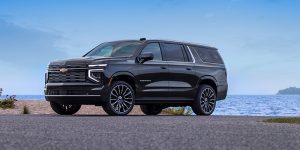
The Suburban is the largest SUV in Chevy’s lineup. It comes with a 5.3L V8 engine that generates 355 hp and 383 lb.-ft of torque. A 420-hp 6.2L V8 is available in higher trims that unlocks the SUV’s maximum towing capacity of 8,300 pounds. A 3.0L Duramax turbo-diesel I-6 with 495 lb.-ft of torque provides excellent fuel economy, with ratings of 27 mpg highway and 21 mog city.
This behemoth can seat up to nine passengers with a setup of three bench seats, making it ideal for extra-large families or regular sports team chauffeurs. Cargo space is also generous, with up to 42 cubic feet behind the third row and a grand total of 145 cubic feet. An available power-sliding center console is available, which can move backwards to create additional space between the front seats or provide easier access for second-row passengers.
Chevy Colorado vs. Silverado: 2025 Showdown
Both the Chevy Colorado and the Chevy Silverado 1500 are known for their ruggedness, durability, strength, and practicality. The mid-size Colorado appeals to truck drivers who enjoy fitting into city parking spaces, while the full-size Silverado 1500 is for pickup purists who require the full range of truck abilities. Today, your local Chevy dealership will explore these two capable options further.
Performance and Towing
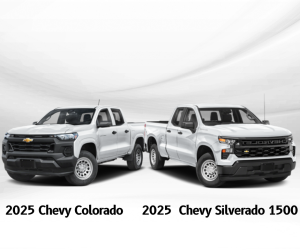
All mid-size Colorado pickups sport a 2.7L TurboMax four-cylinder engine that produces 310 horsepower and 430 lb-ft of torque. It’s paired with an 8-speed automatic transmission. The Colorado has an independent front suspension and a rugged rear suspension with a solid axle and leaf springs for strong load-carrying ability. The truck’s maximum towing capacity is 7,700 pounds, which is highest in its class.
The full-size Silverado 1500 offers drivers a range of engine options. The standard engine is the same TurboMax as in the Colorado. Two available EcoTec V8 engines are available; one with 355 hp and 383 lb.-ft of torque, and one with 420 hp and 460 lb.-ft of torque. Both are paired with a 10-speed automatic transmission. The optional 3.0L Turbo-Diesel engine, which is standard in ZR2 models, produces up to 495 lb.-ft of torque, which unlocks a 13,300-lb towing capacity.
7 Impressive Features of the 2025 Chevrolet Tahoe
The 2025 Chevrolet Tahoe is a full-size SUV that’s loaded with standard features. With its impressive power, space, and technology, it’s the ideal vehicle for daily driving, weekends away, and even towing.
Bold and Functional Exterior
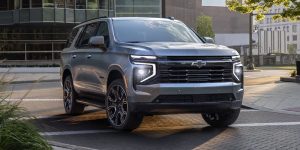
A vehicle this large is going to get noticed, but the Tahoe offers more than just its commanding size. Its newly redesigned front grille and fascia give it a bold appearance. Its 18-inch silver wheels, black assist steps, and roof rails are stylishly functional. It has ultra-modern LED headlamps and tail lights, and it also comes with automatic high beams to make driving at night safer. It comes with convenient Rainsense automatic wipers and heated, power adjustable side mirrors.
Spacious Seating
With its standard configuration, the Tahoe has three spacious rows that seat eight. The LS also has an available front bench seat. With that option, you can seat nine.
Read the rest of this entry »Modern Efficiency: The 2025 Chevrolet Equinox EV
The 2025 Chevrolet Equinox EV is an all-electric SUV that does away with gas pumps while providing exceptional mileage, first-class interior comforts, and impressive versatility in different driving scenarios, making it an ideal choice for both daily drives and adventurous road trips.
Performance That Goes the Distance

Along with its impressive all-electric performance, this edition of the Equinox EV offers both front-wheel-drive (FWD) and all-wheel-drive (AWD) powertrains for you to choose from. When opting for an FWD-equipped model, you can expect 220 horsepower and up to 319 miles in total driving range. AWD-equipped models get up to 285 miles in driving range while boosting output to 300 horses. Regardless of which powertrain you choose, all models have a fully independent suspension system, which provides excellent handling.
Multiple Battery-Charging Options
When you need to replenish the vehicle’s battery, charging is made easy with multiple charging options, including a standard Level 1 charger that can be used while out and about or with a charging station at home and an available Level 2 charger that cuts charging time down to a few hours. Regen on Demand comes standard, which charges the vehicle’s battery whenever you press the brake pedal, and over 200,000 public charging stations can be found across North America.
Read the rest of this entry »Connect with us


- 2026 Chevrolet Silverado 1500
- 2026 Chevrolet Trailblazer
- 2026 Chevrolet Trax
- Air Conditioning
- Blazer EV inventory
- Chevrolet Blazer EV dealer
- Chevrolet Trax dealer
- Chevy Traverse
- Design
- Interior
- Performance
- R & R Auto Financing
- R & R Auto Group Chevy
- R & R Auto Group Service
- R & R brake service
- R & R oil change service
- Safety Features
- Schuylkill Haven Chevrolet Dealer
- Schuylkill Haven Chevrolet Service
- Summer Service
- Technology
- The 2026 SUV Lineup
- Tire Inspection
- Trucks
- Uncategorized